

THE FIGURENOOK FIELD GUIDE · Kitchen & cooking
Choose container sizes from the portions you actually pack
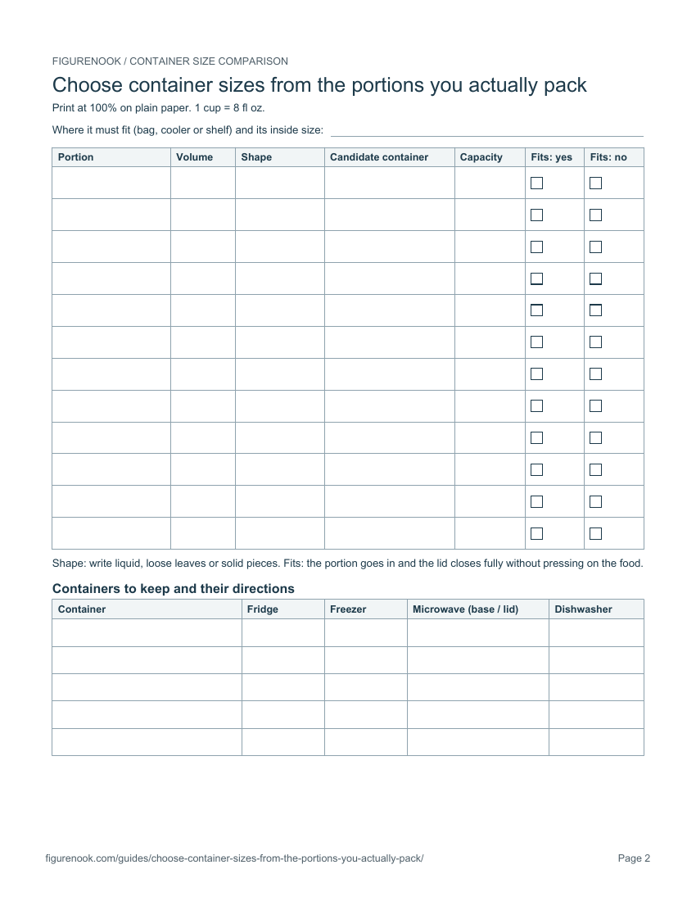
Measure the portions you really pack, then compare each one with the containers you own or are considering. The size comparison table has one row per portion: portion, volume, shape, candidate container, its capacity and whether it fits with the lid closed.
Free instructions. No account or email required.
YOUR FREE PRINTABLE
See what you’ll get.
Preview of a container size comparison table with portion, volume, shape, candidate container, capacity and fits columns.
The preview shows the actual PDF workspace page. Download it free, with no account, email or purchase required. Print a trial page to check the layout.
Download the container size comparison table and guide (PDF)THE METHOD
One step at a time
Measure each typical portion
Spoon each portion you usually pack into a measuring jug or cups and write its volume on the table. Note its shape too: liquid, loose leaves, or solid pieces, because the same volume can need a different container shape. 1 cup is 8 fl oz if a capacity is given in ounces.
List candidate containers
For each portion, write a container you own or are considering and its stated capacity. Check whether advertised set counts include lids. Measure the inside depth so you know how much headroom is left below the lid.
Mark what fits
A container fits when the portion goes in with the lid closing fully and without pressing on the food. Tick Yes or No on the table. Also check the outside footprint against your bag, cooler or cupboard shelf.
Check the use directions
For each container you keep, read the base and lid directions for refrigerating, freezing, microwaving and washing; bases and lids often have different limits. For leftovers, FDA advises dividing large amounts into shallow containers for quicker cooling.
FEATURED PRODUCT
Vtopmart 8 Pack Glass Food Storage Containers with Lids Green
Affiliate link. As an Amazon Associate I earn from qualifying purchases.
Check the selected option, current price and delivery on Amazon. The guide and downloads are free; no purchase is required.
OPTIONAL FEATURED ITEM
Optional item for this project
Use what you already have. The optional featured link opens Amazon; check actual photos, dimensions, included pieces, and instructions. These are project planning ideas and concept illustrations.
Affiliate links. As an Amazon Associate I earn from qualifying purchases.
Vtopmart 8 Pack Glass Food Storage Containers with Lids Green
Optional supply comparison based on manufacturer specifications. Check actual glass-container capacities and lid directions; no universal oven or freezer suitability is implied.
Shop this item on Amazon (opens in a new tab)
Shop Vtopmart 8 Pack Glass Food Storage Containers with Lids Green on Amazon ↗ (opens in a new tab)
Compare specifications and current prices on Amazon before buying. The guide and checklist on this page are free.
Make it work for you
- Fill gaps in your set first; you may only need one or two new sizes.
- Shallow containers help large amounts of leftovers cool more quickly in the refrigerator (FDA).
- Use suitable containers you already own; follow each container and lid manufacturer’s directions.
Original AI editorial illustration of containers, lids and a measured food portion; it is not a photograph of a tested result or specific product.
Source: FDA: Safe Food Handling. FDA recommends dividing large amounts of leftovers into shallow containers for quicker cooling. The portion comparison is FigureNook guidance; 1 US cup equals 8 US fluid ounces.
Guide published October 27, 2026. Tell us about an error or unclear step.
← All creative guides · FigureNook on Pinterest (opens in a new tab)