

THE FIGURENOOK FIELD GUIDE · Kitchen & cooking
Coconut-pudding dessert cups: cool before filling
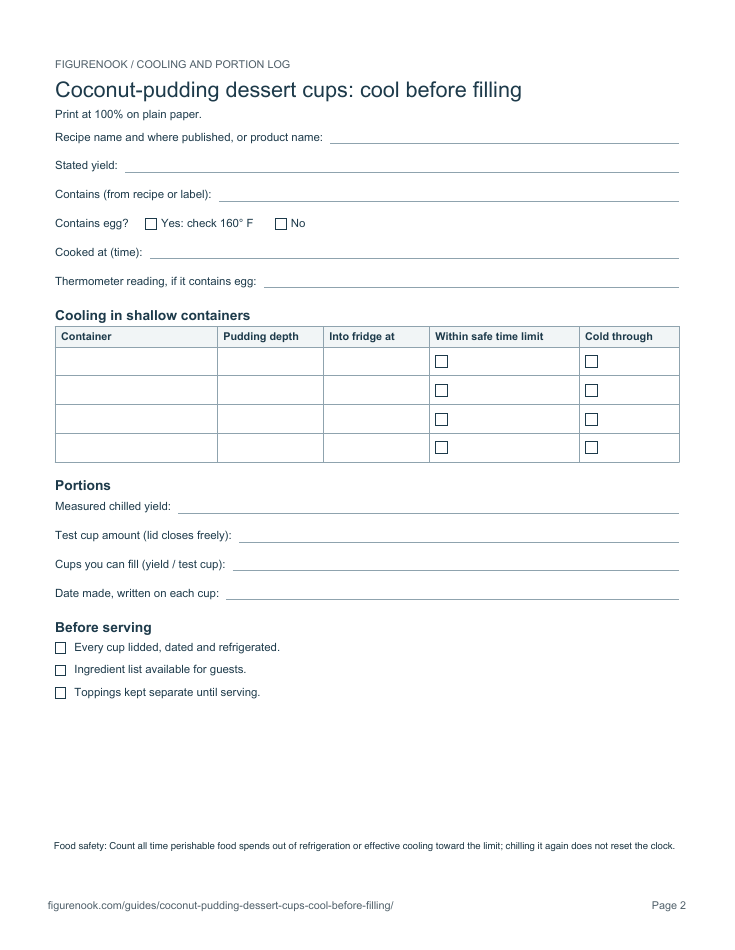
Portion a coconut pudding into small lidded cups only after it has chilled. FigureNook gives no pudding recipe: use ready-to-eat pudding or a recipe you trust. The cooling and portion log records the recipe or product, the cooling times, your measured yield and the amount per cup.
Free instructions. No account or email required.
YOUR FREE PRINTABLE
See what you’ll get.
Preview of a cooling and portion log with recipe or product fields, a shallow-container cooling table and a test-cup portion box.
The preview shows the actual PDF workspace page. Download it free, with no account, email or purchase required. Print a trial page to check the layout.
Download the coconut pudding cooling and portion log (PDF)THE METHOD
One step at a time
Record the pudding you are using
Write the recipe name and where it is published, or the product name, on the log, with its stated yield and ingredients. A coconut name does not mean dairy-free or free of any allergen; check the actual ingredient list.
Cool a cooked pudding quickly
If you cook pudding, follow the recipe. If it contains egg, FDA advises cooking egg dishes to 160 °F, measured with a food thermometer. Divide a large batch into shallow containers and promptly refrigerate: within 2 hours of cooking, or within 1 hour when the temperature is above 90 °F. Do not leave a deep pot on the counter.
Fill the cups once it is cold
Fill only chilled pudding into plastic cups. Spoon one test cup, stopping where the lid still closes without touching the pudding, and write that amount on the log. Divide your measured yield by it to see how many cups you can fill.
Lid, label and refrigerate
Close the lids, write the date made on each cup and refrigerate. FDA says cold perishable food should be kept at 40° F or below. Follow the recipe or package for how long the cups keep.
FEATURED PRODUCT
5oz Plastic Dessert Cups with Lids and Spoons, Clear, 20 Pack
Affiliate link. As an Amazon Associate I earn from qualifying purchases.
Check the selected option, current price and delivery on Amazon. The guide and downloads are free; no purchase is required.
OPTIONAL FEATURED ITEM
Optional item for this project
Use what you already have. The optional featured link opens Amazon; check actual photos, dimensions, included pieces, and instructions. These are project planning ideas and concept illustrations.
Affiliate links. As an Amazon Associate I earn from qualifying purchases.
5oz Plastic Dessert Cups with Lids and Spoons, Clear, 20 Pack
Optional supply comparison based on manufacturer specifications. Cold-serving plastic cups, lids and spoons. Not oven-safe bakeware; check actual food-contact and use directions.
Shop this item on Amazon (opens in a new tab)
Shop 5oz Plastic Dessert Cups with Lids and Spoons, Clear, 20 Pack on Amazon ↗ (opens in a new tab)
Compare specifications and current prices on Amazon before buying. The guide and checklist on this page are free.
Make it work for you
- Note the cooking and refrigeration times; use the shorter one-hour limit when the temperature is above 90 °F.
- Toasted coconut or other toppings stay crisper if added at serving.
- Use cold-serving cups suitable for food; check the cup and lid directions.
- Count all time perishable food spends out of refrigeration or effective cooling toward the limit; chilling it again does not reset the clock.
- Do not use cold-serving cups for oven use or hot food; follow the maker's instructions.
AI concept illustration: the image is an original AI editorial illustration of coconut pudding cups, not a photograph of a tested result or of the linked product. It does not establish colour, capacity, fit, temperature or results; check the retailer listing and the maker's directions.
Source: FDA: Safe Food Handling. FDA guidance supports the 160 °F temperature for egg dishes, prompt refrigeration, shallow containers for quick cooling and refrigerator temperatures at 40 °F or below. This guide offers a planning log, not a pudding recipe.
Guide published October 27, 2026. Tell us about an error or unclear step.
← All creative guides · FigureNook on Pinterest (opens in a new tab)